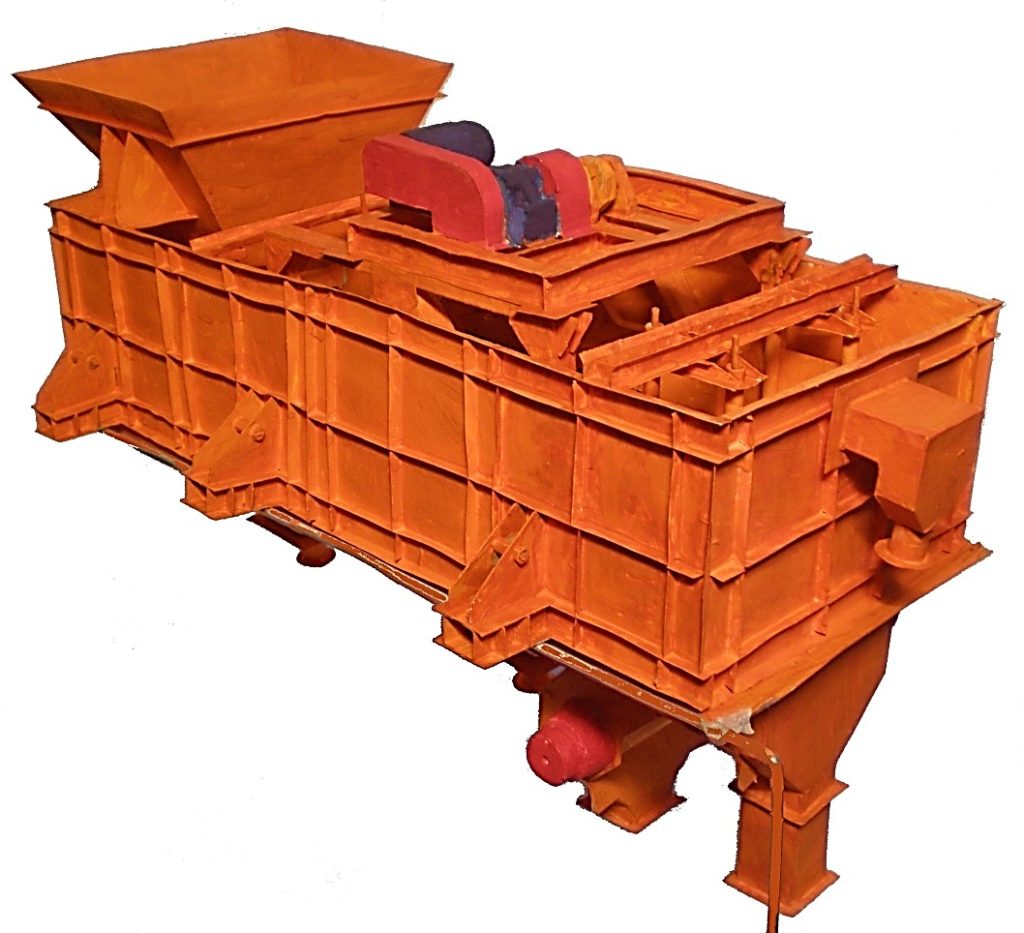
The VOM vibratory coal beneficiation machine is designed to beneficiate coal with a particle size of 0.5–150 mm.
Beneficiation principle
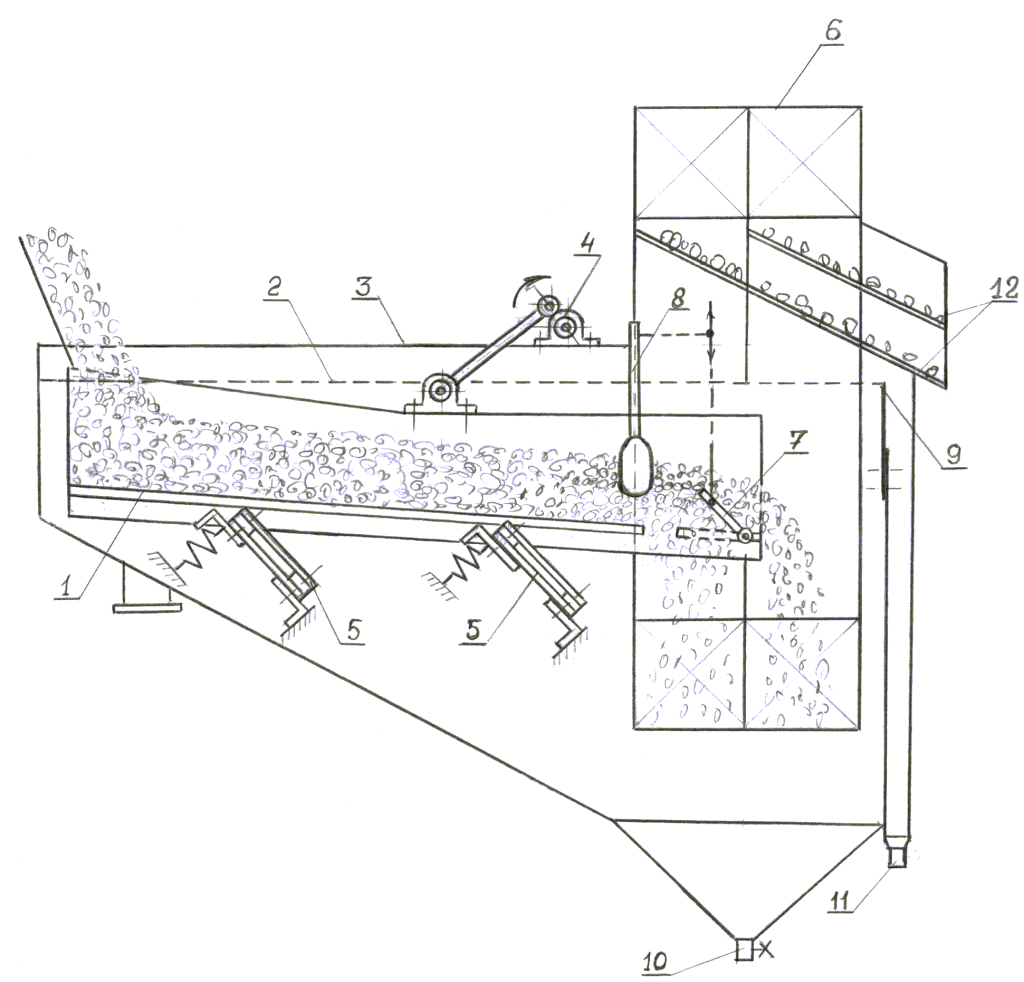
Beneficiation takes place as a bed of material is vibro-conveyed along a deck that performs two-component vibrations directed at an angle in water.
During vibro-conveying, vibrational, hydrodynamic, gravitational and contact forces stratify particles of different density across the height of the run-of-mine bed on the deck. Lower-density particles (coal) move to the top of the bed and rock moves to the bottom. After a certain number of deck vibration cycles, the relative movement of the “heavy” and “light” particles stops, and each particle settles at the height in the bed that corresponds to its density.
Vibratory separation takes place in still water without hutch water or transport water. This solves the problem of the large specific volumes of process water consumed in jigging (up to 3.8 m³/t).
In vibratory beneficiation, process water is used only to remove fine run-of-mine particles through the deck and slimes over the overflow weir. This ensures continuous discharge of fine particles and keeps their concentration in the machine body within acceptable limits.
The separation intensity depends on the deck vibration parameters, the density difference between the particles, the thickness of the bed on the deck and the design of the load-bearing surface elements. With a run-of-mine bed thickness of 300 mm and optimal vibration parameters, the average separation velocity of coal and rock particles (with densities below 1.5 g/cm³ and above 1.8 g/cm³ respectively) is 4.6–6.2 mm/s.
Main specifications of the VOM2
| Parameter | Unit | Value |
|---|---|---|
| Size range of coal beneficiated | mm | 6.0 (3.0) – 150 |
| Throughput, up to | t/h | 100 |
| Separating deck area | m² | 3.64 |
| Deck dimensions: length / width | m | 3.64 / 1.0 |
| Deck vibration parameters: amplitude | mm | 20; 25 |
| Deck vibration parameters: frequency | rad/s | 22; 25 |
| Deck vibration parameters: angle of vibration direction | deg | 45; 60 |
| Deck inclination to the horizontal | deg | 0 |
| Run-of-mine bed height in the separation zone | m | 0.3 |
| Vibration exciter type | — | eccentric |
| Exciter drive motor power (3-phase, 380 V) | kW | 18.5 |
| Rotary discharger drive motor power | kW | 3.0 |
| Power of the process water level control system (220 V) | VA | 8.0 |
| Specific process water consumption: nominal / maximum | m³/t | 0.5 / 1.3 |
| Specific process water supply rate: nominal / maximum | m³/t | 0.39 / 2.0 |
| Overall dimensions: length / width / height | mm | 660 / 2800 / 3900 |
| Machine weight without water and process load | kg | 9300 |
| Process water volume in the machine body | m³ | 20 |
| Recovery efficiency of fractions with density below 1800 kg/m³ | % | 82…92 |
| Contamination of the recovered fraction by fractions above 1800 kg/m³ | % | 9…12 |
Separating rock from development run-of-mine
Based on this vibratory machine, a technology has been developed for separating rock from the run-of-mine produced by roadway development. The technology reduces irrecoverable losses of combustible matter with the rejects and eliminates unskilled manual coal picking.
- Few operations in coal preparation and separation.
- Low capital costs and low beneficiation costs with minimal liquid waste.
- Efficient coal recovery, with the quality of the saleable product adjustable to its intended use.
Given the favourable auxiliary conditions (no circulating water required, low specific energy and process water consumption, minor costs for auxiliary equipment), rock separation on a vibratory machine with an oscillating deck compares well economically with other processes of the same purpose.
Preliminary rock removal at the preparation plant
The vibratory machine can also be used for preliminary removal of rock from the coarse coal size classes fed to the beneficiation units. Introducing this process at a coal preparation plant will make it possible to:
- Reduce the load on the beneficiation units and recover more combustible matter into the saleable product while reducing its contamination.
- Reduce losses of combustible matter with the beneficiation rejects.
- Reduce wear and improve the reliability of coal preparation equipment.
- Reduce degradation of coal particles during subsequent handling and beneficiation, and hence increase the yield of sized coal and reduce dust and slime generation.
Compared with similar machines, the vibratory coal beneficiation machine is simpler in design, in set-up and in maintaining stable operating modes. Thanks to its low process water consumption, its technical and economic performance is better. The vibratory beneficiation principle makes it possible, by simple technical means, to apply different types of vibratory action to the material along the deck length, using asymmetric and other types of deck vibration.