Beyond coal and ore beneficiation, MVG polyfrequency screens have a number of promising applications, from sizing river gravel to mechanical wastewater treatment.
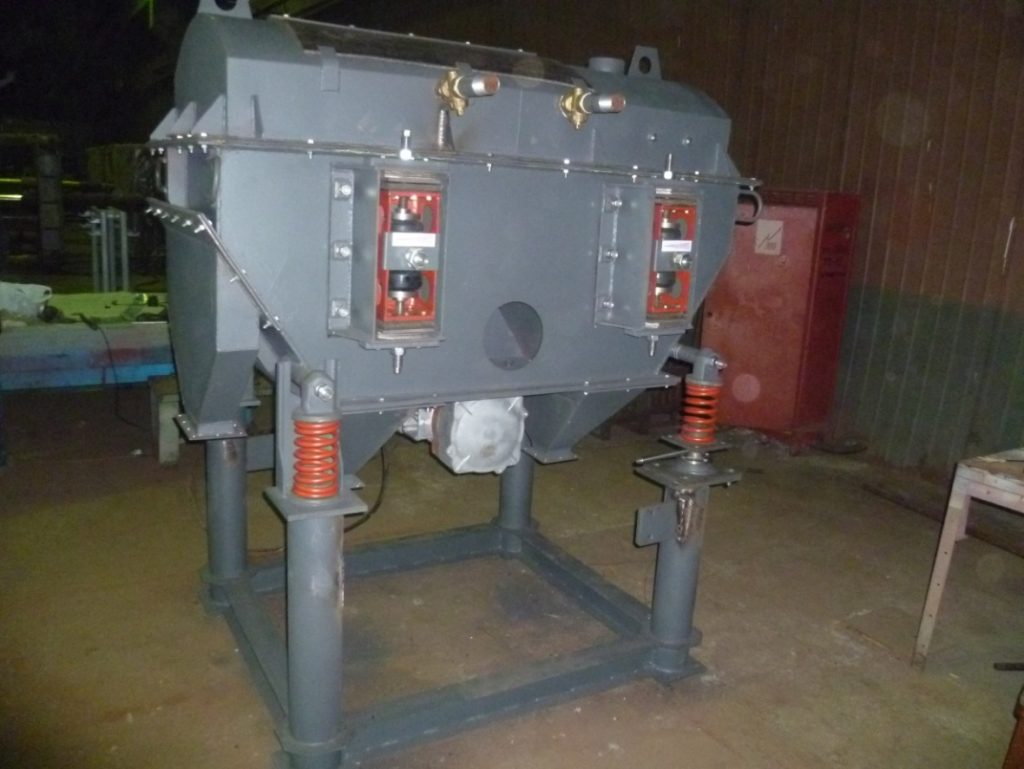
Sizing of hard rock
MVG polyfrequency vibrating screens can be used for sizing (classification) and dewatering of hard rock, including river gravel, at particle sizes from 20 microns to several millimetres. Sizing, separation and dewatering of hard rock take place on woven wire mesh, which gives the working surface a long service life. Screen media last considerably longer, and their replacement costs an order of magnitude less than on conventional screens.
During sizing, aperture blinding is prevented and agglomerates of stuck-together particles (including clay agglomerates) are broken up. This delivers much higher sizing and dewatering efficiency than conventional screens and keeps the mesh continuously self-cleaning.
Since no additional loads are transmitted to the supporting structure (apart from the dead weight of the screen and the material), the screen is installed without special foundations, including on the floor slabs of buildings and structures. Sizing can be carried out at high temperatures and in aggressive media, including under water.
A standard size range of screens has been developed, with screening areas from 1 to 4 m² and different numbers of decks. A single screen sizes river gravel at a throughput from 8–10 to 32–40 t/h.
Kaolin processing
At the dry processing plant of PROSCO Resources LLC (Prosianivskyi Mining and Processing Plant), kaolin was separated at −100 µm on the MVG 1.0 polyfrequency screen with an effective screening area of 0.9 m² to improve product quality. Particles of +100 µm were removed from the finished product (kaolin with moisture up to 1 %) with minimal losses of the useful product.
Recovery of dried distillers’ grains from alcohol production waste
There is positive experience in recovering dried distillers’ grains from alcohol production waste for further use as a feed additive. The screen provided sufficient throughput and degree of product dewatering. Recovering dried distillers’ grains from the waste also prevents environmental pollution.
Wastewater treatment
As with drilling fluids, polyfrequency screens are well suited for wastewater treatment: separating micron-sized silt particles to clarify the water and removing contaminants from domestic and industrial wastewater before it is discharged into water bodies.
Mechanical treatment on polyfrequency screens should be applied at the preliminary stage, whose purpose is to retain coarse and fine impurities before subsequent biological treatment. The ability of polyfrequency screens to separate and dewater fine (micron) fractions will significantly improve the efficiency of the mechanical treatment stage.