Improving the removal of drilled cuttings from drilling fluids, increasing the rate of penetration and improving drilling fluid quality are pressing challenges for the oil and gas industry.
A new-generation technology for removing drilled cuttings from drilling fluids on the MVG polyfrequency vibrating screen has been developed. Its distinctive feature is polyfrequency vibration, with screen deck accelerations on MVG screens more than 25 times higher than on standard screens. This delivers higher throughput and cleaning efficiency than conventional shale shakers with single-frequency deck excitation and accelerations of up to 60 m/s².
A higher rate of penetration permitted by solids control directly improves the technical and economic performance of well drilling.
Laboratory studies
Laboratory studies of removing rock particles from drilling fluid were carried out on the MVG 1.0 screen with an effective screening area of 0.9 m², using fluid already cleaned by the solids control equipment of the K-160 drilling rig. The studies established the following:
- When rock particles are separated from the drilling fluid, the screen decks of the MVG screen are not blinded by drilled cuttings; particles do not stick to the screen surface and require no additional cleaning, unlike separation on Brandt shale shakers.
- Weighting agent losses when cleaning drilling fluid on MVG screens are lower than on the K-160 drilling rig equipment.
- The residual moisture of rock particles after separation on the MVG screen does not depend on the screen aperture and amounts to 15.7 %. Accordingly, drilling fluid losses when cleaning on the MVG screen are 15.7 % rather than 100 % as on Brandt shale shakers.
The results showed that polyfrequency vibrating screens can successfully clean drilling fluid at a cut size of 25 µm, eliminating the additional cleaning stage on desanders and desilters from the existing flowsheet.
Industrial trials
Industrial trials of the drilling fluid cleaning technology on an experimental MVG 1.0 polyfrequency vibrating screen were carried out at the K-160 Volodarska-2 drilling site of PJSC Zasiadko Mine. The aim of the trials was to determine the technical and economic performance of drilling fluid cleaning.
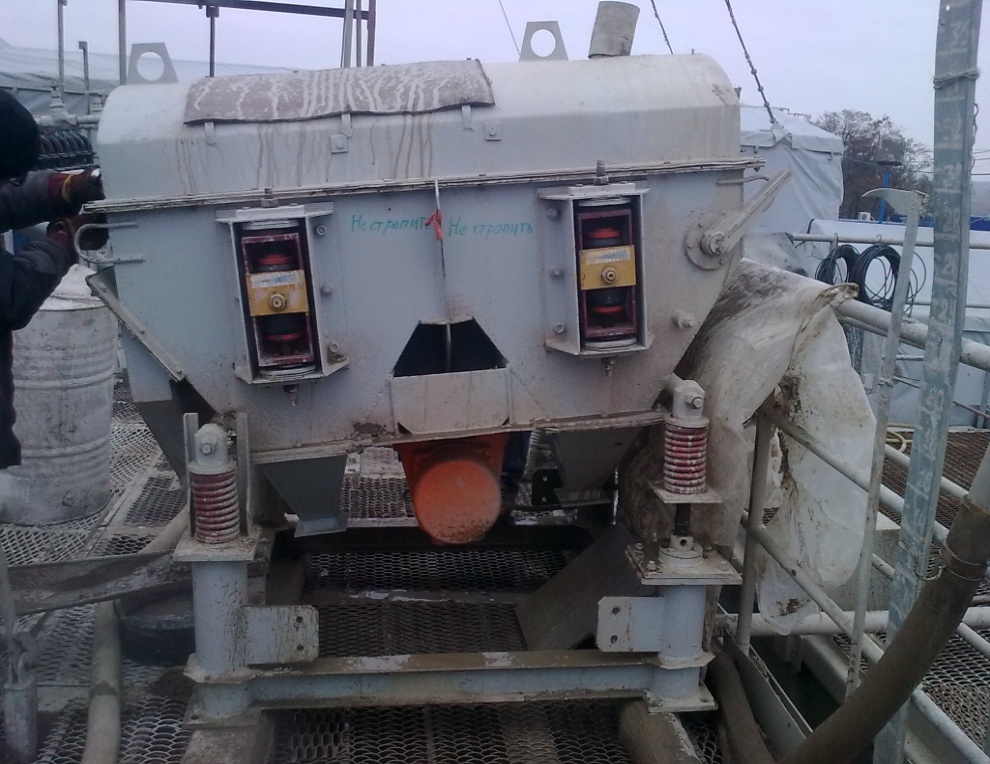
The cleaning performance of the MVG 1.0 screen was compared with that of the stationary equipment installed on the K-160 rig: two identical Brandt shale shakers, Brandt desanders and desilters, and an OGSh 490U-01 decanter centrifuge.
The trials produced the following results:
- The MVG screen removes solid rock particles and colloidal clay from the drilling fluid better than the stationary Brandt units. Compared with Brandt shale shakers, cleaning on the MVG screen reduces drilling fluid losses with the separated rock particles.
- When solid rock particles and clay are removed, the screen apertures are not blinded and clay does not stick to the screen surface. No additional water needs to be supplied to the screen deck.
- Cleaning throughput rises almost in proportion to the screen aperture size.
| Screen aperture, µm | Cleaning throughput, m³/h |
|---|---|
| 25 | 6.0 |
| 56 | 6.5 |
| 80 | 10.0 |
| 150 | 28.0 |
In terms of technical and process parameters, the new technology outperforms conventional drilling fluid cleaning technologies in reliability, ease of maintenance and cost of screen replacement. It reduces the number and types of units required while improving the quality of drilling fluid cleaning and increasing cleaning throughput, and hence the rate of penetration.
The trial results support recommending MVG polyfrequency vibrating screens for drilling fluid cleaning in place of existing technologies. A standard size range of screens with screening areas from 1 to 4 m² and different numbers of decks has now been developed.