The technology of vibro-pulse treatment of the near-wellbore zone of productive formations is designed to increase the production rate or injectivity of wells.
Schematic diagram of the generator
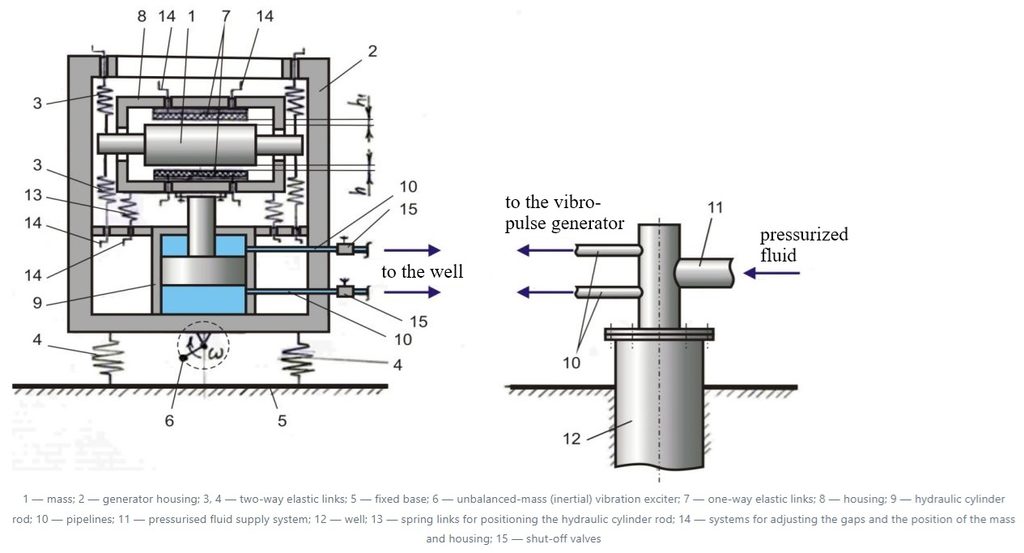
Main generator specifications
| Parameter, unit | Value |
|---|---|
| Excitation frequency range, kHz | 0–22 |
| Type of electromechanical vibrator | Explosion-proof EVV-25.0-1500 (or equivalent) |
| Nominal angular speed of the vibrator, rad/s | 153.8 |
| Induction motor power, kW | 1.5 |
| Exciting force, kN | 23.7 |
| Pressure differentials generated, MPa | ±1.0 … ±20 |
| Generator weight, kg | 200 |
| Overall dimensions (length × width × height), mm | 700 × 500 × 500 |
Operating principle
The generator is driven by unbalanced-mass vibration exciter 6 mounted on housing 2. Harmonic vibrations of the housing are transmitted through spring links 3 to mass 1 and are limited by one-way spring links 7, mounted on housing 8 with gaps relative to mass 1. Housing 8 is attached to the rod of hydraulic cylinder 9, whose chambers are connected via pipelines 10 to system 11, which supplies pressurised fluid into well 12.
The intensity and characteristics of the pressure pulses in the well are controlled by changing the parameters of the vibro-impact vibrations of mass 1 and the positions of shut-off valves 15. The adjustable generator parameters are the force produced by the exciter and the gaps to the one-way spring links. Adjusting them changes the spectrum of the generator’s polyfrequency vibrations and the vibration amplitudes at the excited frequencies.
When the vibro-pulse generator is switched on, alternating or sign-changing hydraulic pressure pulses are produced in the “well — near-wellbore zone — formation” system. Owing to the continuous broad frequency spectrum, the pressure pulses travelling down the well to the productive formation coincide with the natural frequencies of local structures of the stressed rock mass and excite resonances of the formation structures in a local volume of the rock mass, releasing their internal energy.
As a result, the stress state of the rock mass is redistributed towards equalisation of internal stresses through micro-displacements of the local structures that make up the rock mass, with the formation of new filtration channels, development of microcracks and cleaning of existing filtration channels.
Vibration characteristics
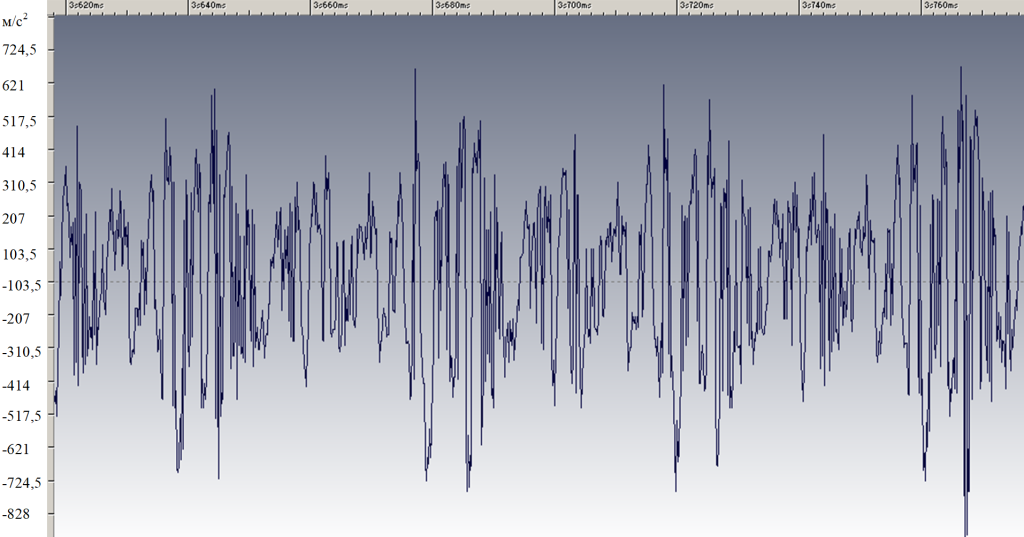
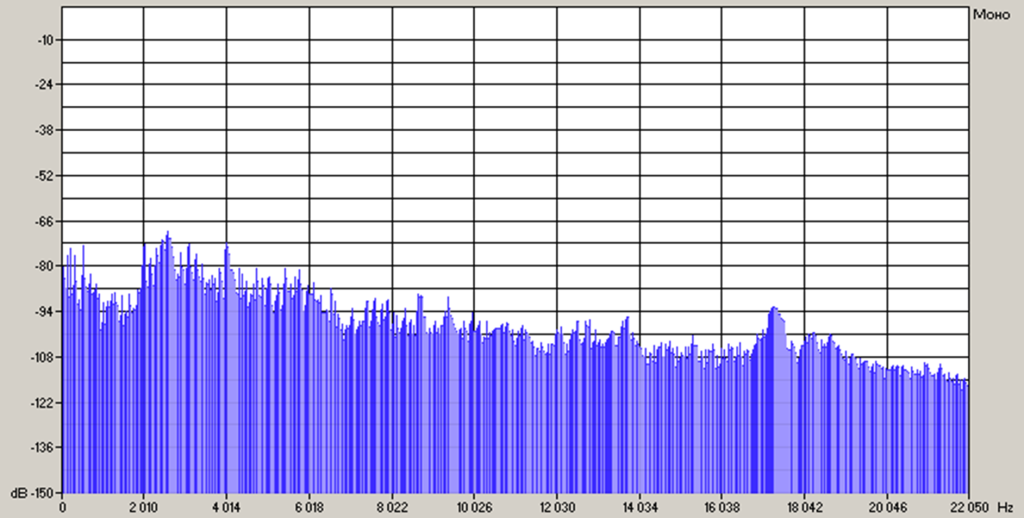
Oscillogram of accelerations and spectral composition of vibrations produced by the vibro-pulse generator
Key distinctive features of the technology
- Generation of nonlinear fluid vibrations in the well.
- A polyfrequency spectrum of hydrodynamic pressure pulse variation.
- The contribution of low-frequency components to the vibration energy increases with distance from the source.
- No need to adjust the pressure pulses to changing conditions in the “well — near-wellbore zone — formation” system, as conventional stimulation technologies require.
Benefits of the technology
- Higher production rate (injectivity) of wells.
- Higher permeability of the near-wellbore zone of the formation.
- More efficient degassing of coal seams.