Burning coal at thermal power plants (TPPs) produces large volumes of ash and slag materials (ASM). Their dumps occupy vast areas, and maintaining them involves considerable operating costs. Ash removal and dump maintenance account for about 30 % of the cost of the energy and heat produced by a combined heat and power plant.
ASM pollute the environment and pose a hazard to human health and a threat to the flora and fauna of the surrounding areas.
Why the ash is not used
The composition and properties of TPP ash and slag depend on the mineral composition of the fuel and the way it is burnt. The decisive parameter for using ASM is the unburned carbon content. Unburned carbon residues in fly ash promote corrosion of reinforcement and concrete and reduce the strength of concrete.
At most Ukrainian TPPs, the unburned fuel content of ASM reaches 20–30 %. Under the European standard “Fly ash for concrete”, loss on ignition must not exceed 5 % by mass. Ash processing can only be profitable if equipment is available to separate the carbon fraction from the fly ash.
Research results
The results of studying the particle size distribution and density composition of fly ash from the Prydniprovska TPP (Ukraine) are given below for 1280 g of product with an ash content of 80 %. The analysis shows that, if the coal content of the ash must not exceed 5 %, the product suitable for building materials is the 0–40 µm fraction. The plus 40 µm fraction contains 63.2 % coal and is therefore well suited for re-burning in TPP furnaces.
| Fraction, µm | Yield γ, g / % | Ash content Aз, % |
|---|---|---|
| −40 | 960 / 75 | 95 |
| 40…50 | 39 / 3 | 51.57 |
| 63…80 | 140 / 11 | 37.21 |
| 80…100 | 122 / 9.5 | 32.58 |
| 125…160 | 14 / 1.1 | 29.06 |
| 160…200 | 1.5 / 0.12 | 35.62 |
Fly ash with a high content of fine particles cannot be separated by existing equipment to remove its carbon-rich fractions. Mechanical separation on mesh is impossible because the apertures become blinded by adhering material, and pneumatic separation is ineffective because it cannot capture precisely the fine dust particles, which are the most valuable and at the same time the most hazardous to people and the environment.
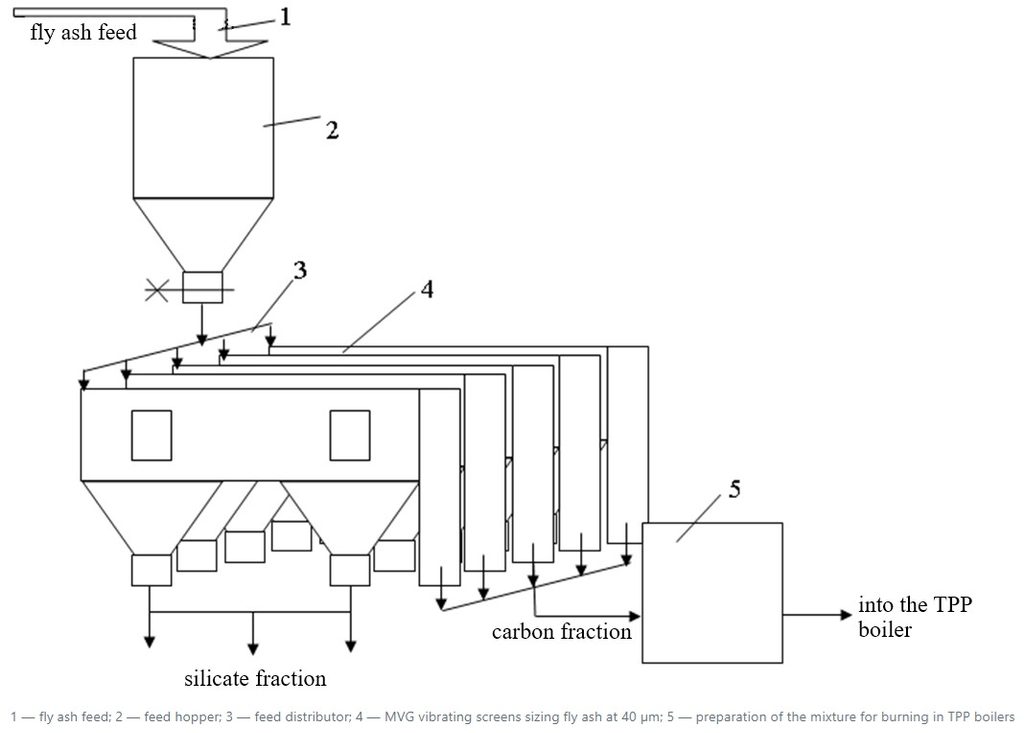
Separation on MVG screens
Laboratory studies of separating fly ash from the Prydniprovska and Burshtyn TPPs were carried out on the MVG 1.0 screen with an effective screening area of 1.0 m², using mesh with a 0.042 mm aperture. A total of 500 kg of ash was processed: 350 kg from the Burshtyn TPP and 150 kg from the Prydniprovska TPP.
The MVG 2.0 screen with an active screening area of 2.6 m² can be used to separate fly ash. The screen design fully seals the process, including feeding and discharging the products. Operating the screen requires neither a special foundation nor staff training.
Conventional screens with harmonic vibration of the screening surface cannot size TPP fly ash because the material clogs the mesh apertures. Polyfrequency vibrations of the mesh, by contrast, prevent aperture blinding, break up agglomerates and mix the particles intensively. Since the mesh is not tensioned, it has a long service life.