The MVZ2 polyfrequency vibratory mill with a straight-through grinding chamber is designed for fine and ultrafine grinding of mineral particles with a feed size of 2.5–3.0 mm.
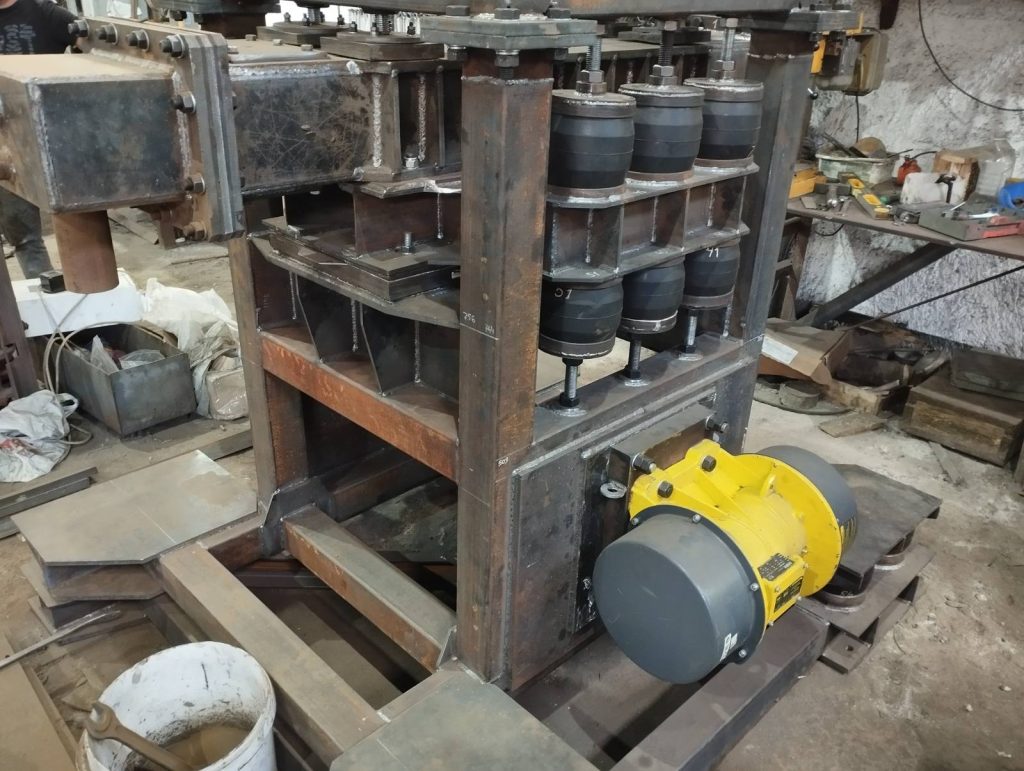
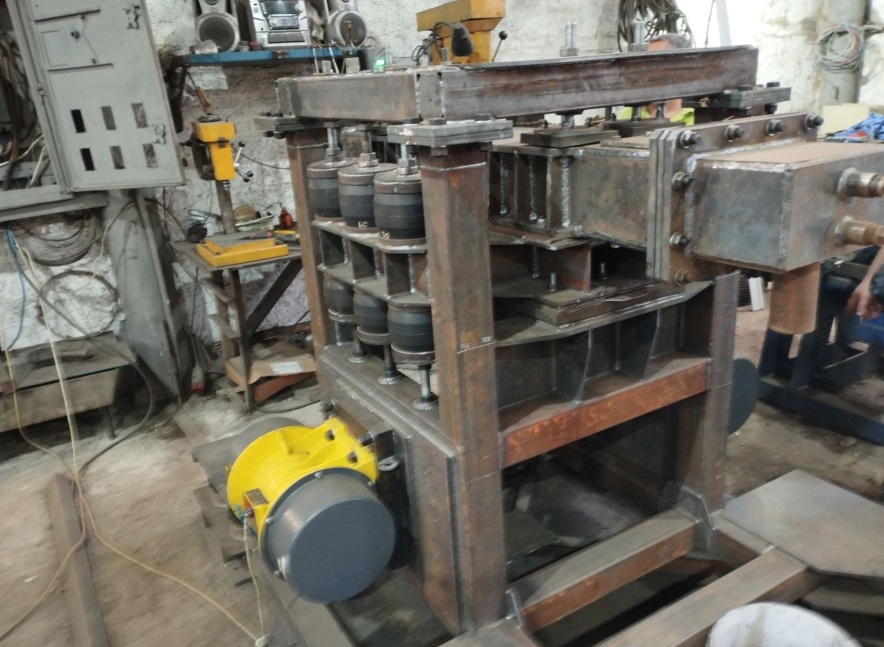
MVZ2 polyfrequency vibratory mill
Mill design
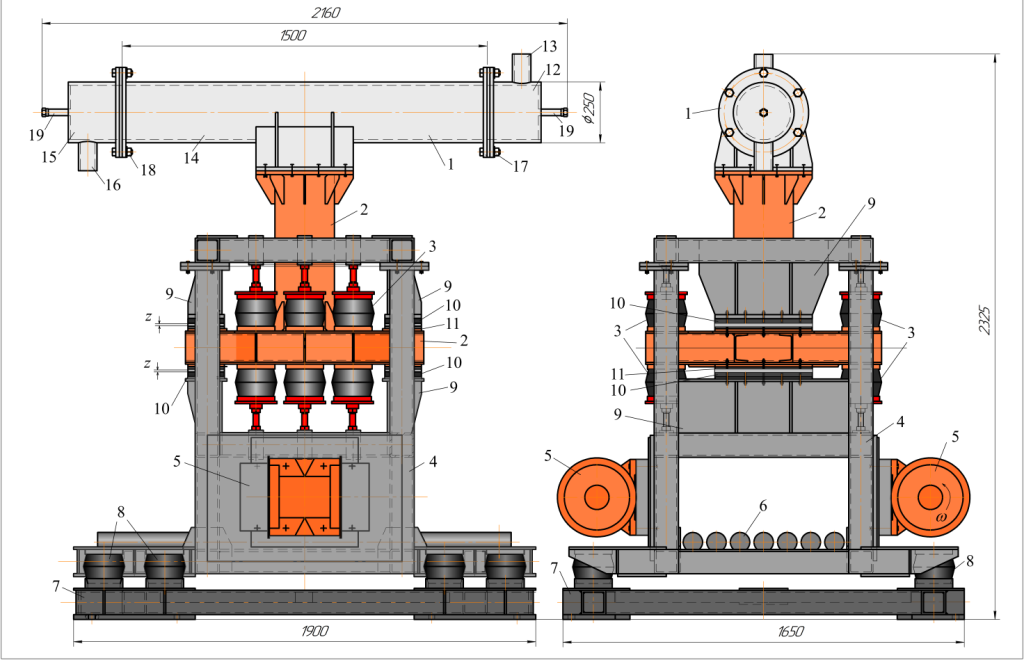
The mill consists of grinding chamber 1, rigidly fixed to impactor 2, which is mounted via elastic elements 3 on drive frame 4. Two electromechanical vibration exciters 5 (type AVM 4300/15 or equivalent) are attached to the drive frame. Their position relative to the frame can be changed by rotating them about their vertical axes of symmetry and fixing them horizontally, at 45° or vertically.
Reactive masses 6 in the form of metal rods are mounted on the drive frame to tune the mill’s operating modes. The drive frame rests on support frame 7 via elastic elements 8. The travel of impactor 2 relative to the drive frame is limited from above and below by stops 9 via elastic elements 10. The amplitude of the impactor travel is adjusted by changing the gaps between anvils 11 and elastic elements 10 on stops 9, and by changing the static moment of the unbalanced masses on the exciter shafts.
Operating principle
When vibration exciters 5, mounted on the drive frame with counter-rotating unbalanced shafts, are switched on, the drive frame and the impactor with the grinding chamber and the process medium inside it perform vertically directed circular vibrations. With the gaps in the mill’s vibrating system properly set, resonant vibro-impact polyfrequency vibrations are produced.
The nonlinear polyfrequency vibrations of the grinding chamber with the process medium are intensified to accelerations of hundreds of m/s², while the drive frame with the exciters vibrates at accelerations of tens of m/s². This ensures the durability of the exciters, which are the most vulnerable to dynamic loads, and of the mill’s dynamic system as a whole.
The material in the chamber is ground mainly by impacts of the grinding media against each other and against the bottom of the grinding chamber. Under back-pressure, the material passes from the feed chamber into the grinding chamber, moves along it, is ground and discharged through the openings in the partition, and then leaves the chamber through the outlet pipe. The fittings are used to fill the grinding chamber with inert or other gases when grinding has to be carried out in a gas atmosphere.
Specifications
| Parameter | Unit | Value |
|---|---|---|
| Maximum feed particle size | mm | 3.5 |
| Minimum particle size of the ground product | µm | a few µm |
| Volume of the chamber with grinding media | m³ | 0.07 |
| Volume of grinding media charge | m³ | 0.061 |
| Mass of steel balls Ø 0–30 mm in the grinding chamber | kg | 300 |
| Throughput for the −60 µm size class when grinding ilmenite* | kg/h | up to 125 |
| Number of vibration exciters, type AVM 4300/15 | pcs | 2 |
| Exciter power | kW | 2.8 |
| Rotational speed of unbalanced shafts (synchronous) | rpm | 1500 |
| Supply voltage | V | 380 |
| Supply frequency | Hz | 50 |
| Centrifugal force | kN | 44.17 |
| Mill weight without process load | kg | 2650 |
| Overall dimensions: length / width / height | mm | 1900 / 1650 / 2325 |
* Size composition of the ilmenite: +400 µm — 27.54 %; −400+100 µm — 71.05 %; −100+63 µm — 1.23 %; −63 µm — 0.18 %; grinding efficiency 37.55 %.
Application example
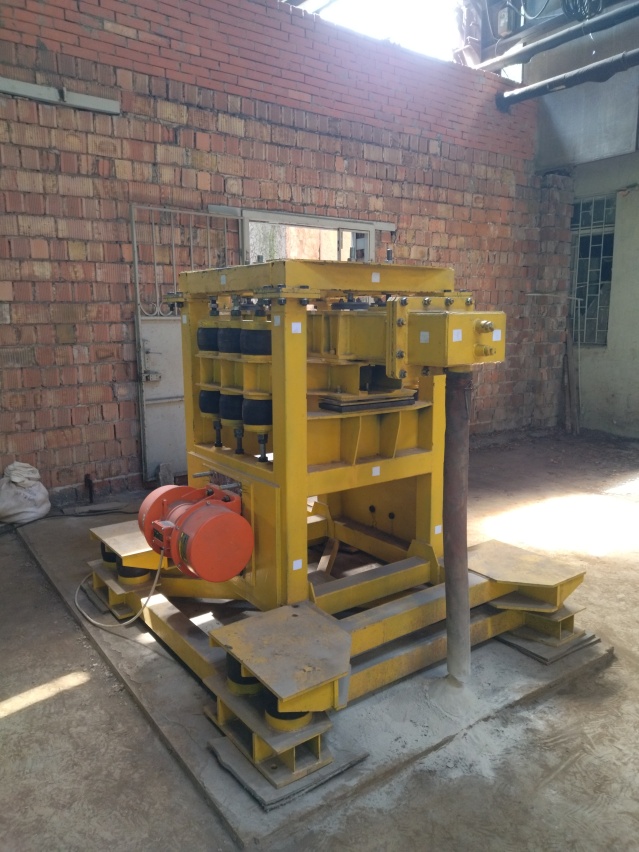
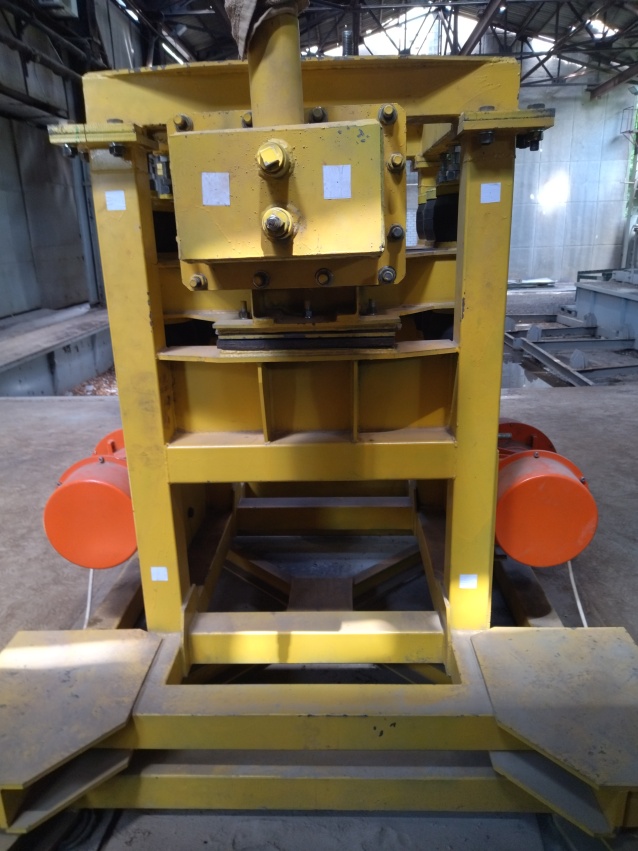
Fine grinding of sand in the MVZ2 polyfrequency vibratory mill