Coal slimes containing non-slaking rock impurities (anthracite, coking coal) require beneficiation to reduce their ash content. MVG polyfrequency screens make it possible to size fine materials from tens of microns at an economically viable throughput and to dewater them to a residual moisture of 17–23 %.
Unlike slimes of coal with slaking clay host rocks (grades DGR, GR, run-of-mine), from which low-ash size fractions can be separated, slimes with non-slaking rock impurities require a dedicated technology.
Process flowsheet
To beneficiate and recover coal from the slime products of anthracite or coking coal preparation, polyfrequency vibrating screens are used in a circuit with spiral separators (spiral concentrators). The spiral separators beneficiate the +50 (+100) µm coal fractions, while the polyfrequency screen recovers this fraction from the pulp with a high content of −50 (−100) µm rock particles and dewaters the coal.
Process flowsheet for beneficiation of liquid coal slimes
For processing coal preparation slime products, the MVG 2.0 and MVG 2.0-22 polyfrequency vibrating screens have been developed; they differ in effective area and in the number of screening decks.
Research results
Tables 1 and 2 give the results of separating slime from the Duvanska central coal preparation plant (CPP) of OJSC Krasnodonvuhillia (Ukraine) on the MVG 1.0 screen and the sieve analysis of the feed slime.
The slime waste of the Duvanska CPP consists mainly of flotation tailings of grade Zh (coking) coal with a small content of clayey particles. This lowers the residual moisture of the oversize product compared with separating slimes from the Pavlohradska CPP of PrJSC Pavlohradvuhillia (grades G and DG with host rocks prone to slaking and sliming).
| Screen aperture, mm | Pulp density, g/l | Pulp throughput, m³/h | Solids throughput, t/h | Oversize yield > cut size, % | Oversize yield < cut size, % | Total moisture, % |
|---|---|---|---|---|---|---|
| 0.071 | 100 | 20.0 | 2.0 | 98.2 | 1.8 | 20.3 |
| 0.071 | 250 | 16.8 | 4.2 | 99.1 | 0.9 | 19.6 |
| 0.1 | 100 | 24.0 | 2.4 | 98.0 | 2.0 | 18.9 |
| 0.1 | 250 | 20.8 | 5.2 | 99.0 | 1.0 | 18.1 |
| 0.2 | 100 | 30.2 | 3.0 | 92.5 | 7.5 | 19.6 |
| 0.2 | 250 | 24.4 | 6.1 | 89.5 | 10.5 | 20.4 |
| Size fractions, mm | Fraction yield, % | Ash content Ad, % |
|---|---|---|
| > 0.5 | 12.3 | 38.6 |
| 0.3–0.5 | 18.9 | 53.4 |
| 0.2–0.3 | 28.6 | 67.5 |
| 0.125–0.2 | 23.0 | 71.4 |
| 0.075–0.125 | 10.3 | 71.6 |
| < 0.075 | 7.0 | 72.1 |
| Total | 100 | 62.65 |
The results show that as the screen aperture increases — and with it the proportion of feed particles finer than the cut size — the content of these particles in the oversize product rises. This is due to poorer conditions for such particles to reach the screen and pass through the apertures. Separation efficiency can be improved by selecting a suitable aperture size or by supplying additional spray water to the screen deck.
Industrial trials
Industrial trials were carried out on the MVG 1.0 polyfrequency vibrating screen with an active screening area of 1 m² for sizing and separating a variety of mineral particles from pulps and suspensions.
Separation of liquid coal preparation slime products was studied at the Pavlohradska CPP of PrJSC Pavlohradvuhillia. At the plant, the MVG 1.0 screen was installed in the process line to recover and dewater secondary thickened slimes fed to the screen from a cluster of GTs 350 mm hydrocyclones at a solids content of 600–680 g/l. The slimes were separated on screens with 0.1 × 0.1 mm apertures. Given this feed pulp density and the absence of additional repulping water, the screen acted as a dewatering and partly beneficiating unit.
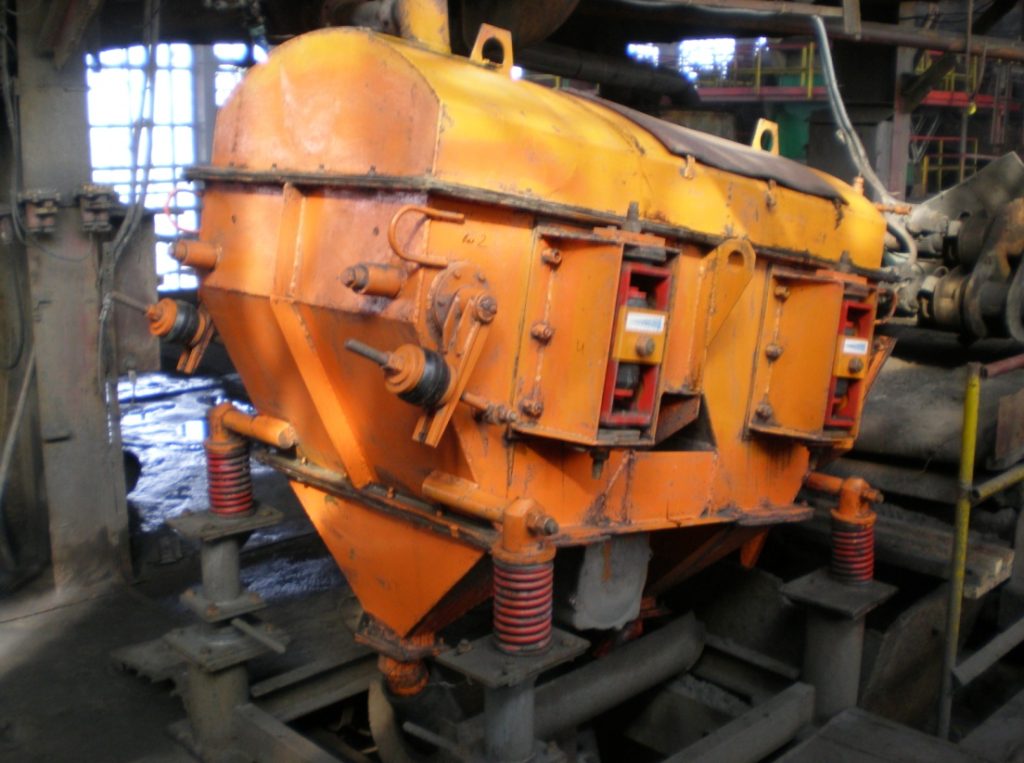
In total, about 14,000 m³ of thickened secondary slimes were processed during the trials, yielding over 4450 thousand tonnes of oversize product (3000 t on a dry basis) with an average ash content of 30 % and a moisture of 200 %. The average ash content of the undersize product was 79 %. No additional spray water was supplied to the screen deck to wash the oversize product and reduce its ash content, since its quality met the requirements of the CPP.
Depending on the feed rate and the feed characteristics (solids content, ash content, particle size distribution and density composition), the screen’s oversize throughput ranged from 2.0 to 4.3 t/(h·m²). There was no blinding of the screen apertures by particles and no adhesion of rock particles to the screen surface, which is typical when such slimes are separated on other types of vibrating screens.
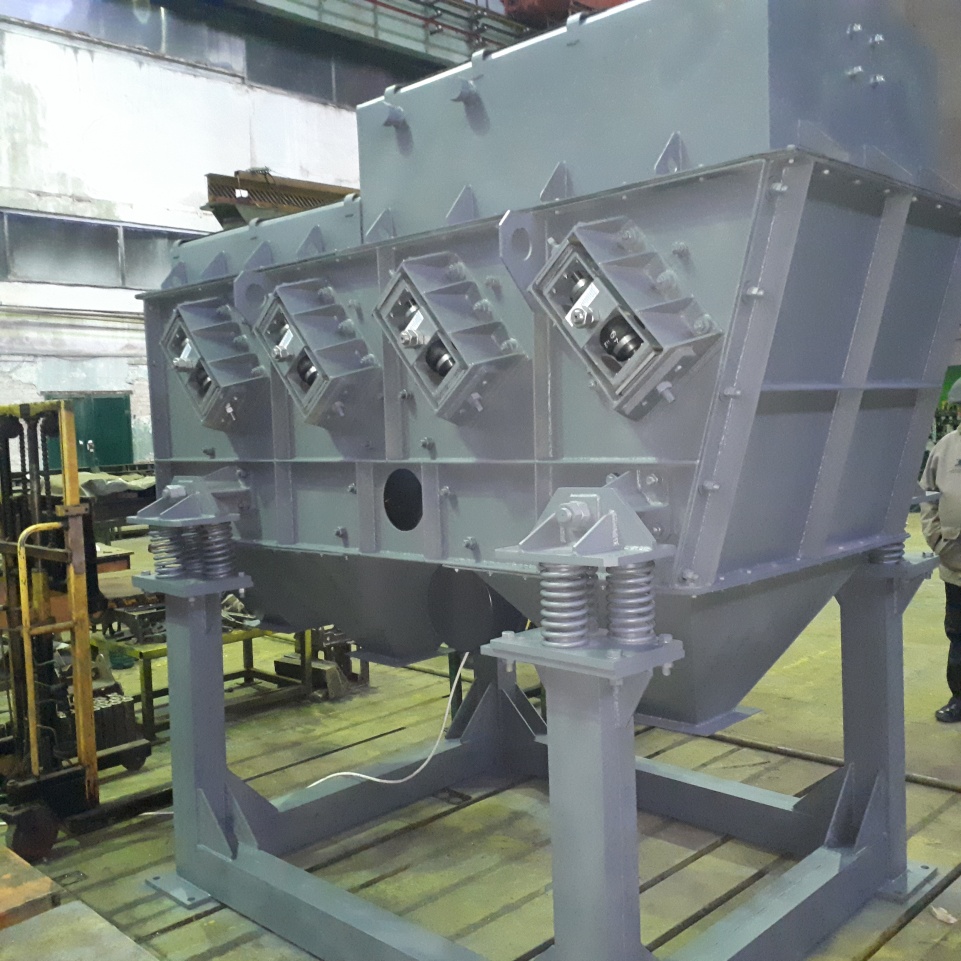
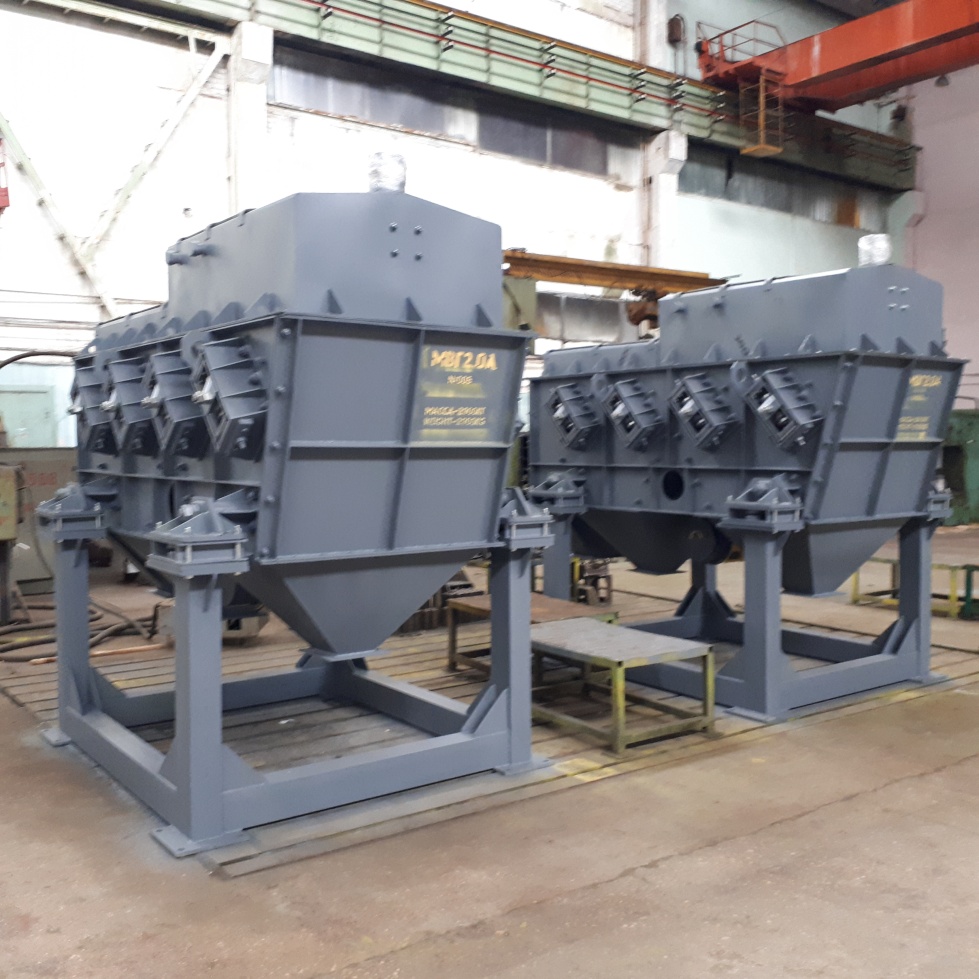
Industrial prototypes of MVG 2.0 polyfrequency vibrating screens for coal beneficiation
Fine screening and dewatering of coal on the MVG 2.0 polyfrequency screen